https://ift.tt/eA8V8J
You can add more than 30 people to a group FaceTime call. Here's how to video call multiple people on an iPhone, iPad or Mac. We also have advice on why Group FaceTime might not work.
from Latest iPhone Articles from Macworld UK https://ift.tt/2xQmiP2
Monday, December 17, 2018

Best iPhone 2018
https://ift.tt/eA8V8J
Apple sells many iPhones, and the choice is overwhelming. Here we rank each one from first to last to see which iPhone is best for most people
from Latest iPhone Articles from Macworld UK https://ift.tt/2SEoP56
Apple sells many iPhones, and the choice is overwhelming. Here we rank each one from first to last to see which iPhone is best for most people
from Latest iPhone Articles from Macworld UK https://ift.tt/2SEoP56
ASUS Zenfone Max Pro M2: 5 Reasons Why the Latest ASUS Phone Can Replicate the Success of Max Pro M1

via News – MySmartPrice https://ift.tt/2LkMS5Y
Lenovo Z5s Ferrari SuperFast Edition Could be World’s First Phone with 12GB RAM, New Leak Suggests

via News – MySmartPrice https://ift.tt/2R1LudC
New York Times Article Explores Apple's Failed Attempt to Build the Macintosh in California
https://ift.tt/2BnRKmj
The New York Times today printed an interesting article exploring how Apple co-founder Steve Jobs set up a Macintosh manufacturing plant in Fremont, California in the 1980s that failed early on into its tenure.
Titled "When Apple Was Homegrown," the piece by John Markoff offers an insight into Jobs' fascination with Henry Ford's mass automobile manufacturing in Detroit and the high-quality manufacturing capabilities of Japanese companies like Sony, and how Jobs aimed to synthesize the two cultures in a "highly automated" Mac factory.
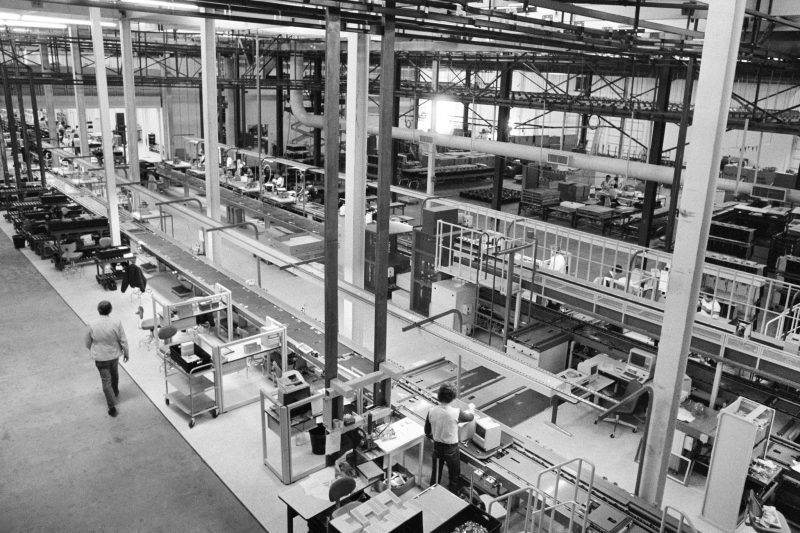
Apple's ill-fated California Macintosh facility (Credit: Terrence McCarthy for NYT)
Jobs made a second attempt to establish a manufacturing culture in Silicon Valley shortly after leaving Apple. In 1990 he oversaw another $10 million plant to build his Next personal workstation. The facility featured robotic devices, but it too was unable to produce in quantities that would support a long-term assembly operation, and it failed just like its Apple predecessor.
Jobs' thinking on manufacturing had changed by the time he returned to Apple in 1997, and the next year he hired veteran supply chain overseer Tim Cook as Apple's senior VP for worldwide operations. Apple's manufacturing outsourcing quickly expanded to form a sprawling ecosystem of global suppliers.
Recently, Apple announced plans to build a new $1 billion campus in Austin, Texas, as well as plans for a general expansion of operations over the next three years in cities across the United States. The plans are expected to create thousands more jobs, although the large majority of them aren't thought to be in manufacturing. Apple says it is on track to create 20,000 jobs in the U.S. by 2023.
Interested readers can find John Markoff's full New York Times article online but with the alternative headline, "Apple Computers Used to Be Built in the U.S. It Was a Mess."
Note: Due to the political nature of the discussion regarding this topic, the discussion thread is located in our Politics, Religion, Social Issues forum. All forum members and site visitors are welcome to read and follow the thread, but posting is limited to forum members with at least 100 posts.
Discuss this article in our forums


from MacRumors: Mac News and Rumors - All Stories https://ift.tt/2EALxaF
The New York Times today printed an interesting article exploring how Apple co-founder Steve Jobs set up a Macintosh manufacturing plant in Fremont, California in the 1980s that failed early on into its tenure.
Titled "When Apple Was Homegrown," the piece by John Markoff offers an insight into Jobs' fascination with Henry Ford's mass automobile manufacturing in Detroit and the high-quality manufacturing capabilities of Japanese companies like Sony, and how Jobs aimed to synthesize the two cultures in a "highly automated" Mac factory.
"Steve had deep convictions about Japanese manufacturing processes," recalled Randy Battat, who joined Apple as a young electrical engineer and oversaw the introduction of some of the company's early portable computers. "The Japanese were heralded as wizards of manufacturing. The idea was to create a factory with just-in-time delivery of zero-defect parts. It wasn't great for business."Construction of the plant, located just across San Francisco Bay from Apple's headquarters, began in 1983. The first reporters to tour it were told that factory labor would account for 2 percent of the cost of making a Macintosh, thanks to its state-of-the-art production line. Expectations were therefore high, but the practical realities of working at the plant were markedly different.
Mr. Gassée, a French specialist in office automation, had just been promoted to president of Apple’s product division by John Sculley, then Apple's chief executive, and was responsible for the company's engineering and manufacturing work. When he first started, Mr. Gassée decided to spend two days learning how the company actually built its products by working on a factory production line.Lacking the requisite schooling and subcontractors, Apple's Macintosh manufacturing in California was unable to reach the production volume that Jobs had envisioned. Eight years later, the plant was shuttered.
[...]
"I embarrassed myself attaching a display to the computer bezel with a screwdriver," Mr. Gassée recalled in a recent interview. At the end of his shift, Mr. Gassée grabbed a broom and swept up the parts that had fallen off the production line. "It was really shameful," he said of the noticeably slipshod process.
Jobs made a second attempt to establish a manufacturing culture in Silicon Valley shortly after leaving Apple. In 1990 he oversaw another $10 million plant to build his Next personal workstation. The facility featured robotic devices, but it too was unable to produce in quantities that would support a long-term assembly operation, and it failed just like its Apple predecessor.
Jobs' thinking on manufacturing had changed by the time he returned to Apple in 1997, and the next year he hired veteran supply chain overseer Tim Cook as Apple's senior VP for worldwide operations. Apple's manufacturing outsourcing quickly expanded to form a sprawling ecosystem of global suppliers.
"When I started my career, all my flights were to Japan," said Tony Fadell, one of the hardware designers of the iPod and iPhone at Apple. "Then all my flights went Korea, then Taiwan, then China."In recent years under Cook's watch as CEO, Apple's complex web of global suppliers has boomed in response to the demand of making products like the iPhone for mass markets. "You can't bring manufacturing back because of those webs," said Andrew Hargadon, a former Apple product designer who worked on the Macintosh Powerbook Duo in the early 1990s. "You would have to bring the entire community back," he told Markoff.
Recently, Apple announced plans to build a new $1 billion campus in Austin, Texas, as well as plans for a general expansion of operations over the next three years in cities across the United States. The plans are expected to create thousands more jobs, although the large majority of them aren't thought to be in manufacturing. Apple says it is on track to create 20,000 jobs in the U.S. by 2023.
Interested readers can find John Markoff's full New York Times article online but with the alternative headline, "Apple Computers Used to Be Built in the U.S. It Was a Mess."
Note: Due to the political nature of the discussion regarding this topic, the discussion thread is located in our Politics, Religion, Social Issues forum. All forum members and site visitors are welcome to read and follow the thread, but posting is limited to forum members with at least 100 posts.
Tags: Steve Jobs, Macintosh
Discuss this article in our forums
from MacRumors: Mac News and Rumors - All Stories https://ift.tt/2EALxaF
Reliance Jio in Plans to Produce 100 Million Affordable 4G Smartphones in Partnership with Flex
via News – MySmartPrice https://ift.tt/2PHUAaK
Microsoft to Opt for Open Source Chromium for its Edge Browser, Will be Available on Mac too
via News – MySmartPrice https://ift.tt/2Ez7pTA
Subscribe to:
Comments (Atom)