Thursday, August 13, 2020

Google Pulls Fortnite From Play Store, But Game Remains Available Through Other Android Sources

https://ift.tt/2PQVqVc

Just hours after Apple removed Fortnite from the App Store, Google has also pulled the Fortnite app from its Google Play Store.


Epic made the same in-app changes in the Google version of the app that it made in the App Store version, allowing players to bypass Google’s in-app purchase system. Subverting the Play Store in-app purchase system is against Google’s rules. From Google’s guidelines:
Developers offering products within a game downloaded on Google Play or providing access to game content must use Google Play In-app Billing as the method of payment.
Google in a statement to The Verge said that it has policies about in-app purchases that are designed to keep the Play Store safe for users. The statement is very similar to Apple’s, in fact.
The open Android ecosystem lets developers distribute apps through multiple app stores. For game developers who choose to use the Play Store, we have consistent policies that are fair to developers and keep the store safe for users. While Fortnite remains available on Android, we can no longer make it available on Play because it violates our policies. However, we welcome the opportunity to continue our discussions with Epic and bring Fortnite back to Google Play.
According to The Verge, Google clarified that it has no issue with Epic distributing the game on Android devices through other channels, but the rules for the Play Store must be followed for the app to be available through it.
Even though the app has been removed from the Play Store, it can still be used on Android. Fortnite can be downloaded through the Epic Games app or through the Samsung Galaxy Store.
This article, "Google Pulls Fortnite From Play Store, But Game Remains Available Through Other Android Sources" first appeared on MacRumors.com

Discuss this article in our forums


from MacRumors: Mac News and Rumors - All Stories https://ift.tt/3gWfFfZ

Apple Launching Discounted $9.99 Per Month CBS All Access and Showtime Bundle for Apple TV+ Subscribers

https://ift.tt/3gW558G

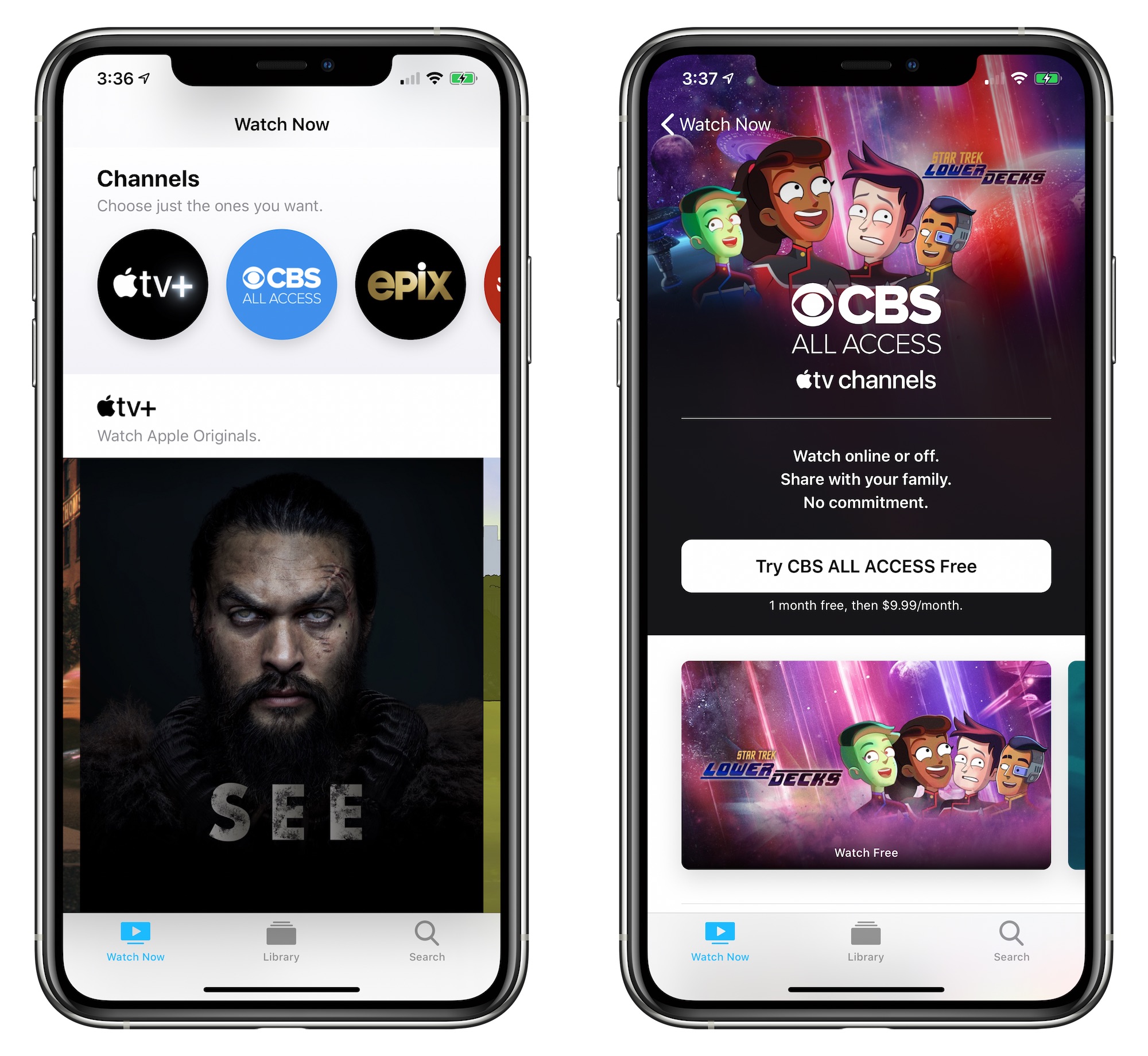
Apple is planning to launch an Apple TV Channels bundle that features CBS All Access and Showtime at a discounted price, reports Bloomberg.


The bundle, which aims to spur usage of ‌Apple TV‌+ and the ‌Apple TV‌ Channels feature, will be priced at $9.99 per month. It is set to roll out as early as Monday, and will be available to those who have an ‌Apple TV‌+ subscription.

Apple already offers access to both CBS All Access and Showtime through ‌Apple TV‌ channels. On a standalone basis, CBS All Access is priced at $9.99 per month and Showtime is priced at $10.99 per month, so this will be a significant savings for those who choose to subscribe through the ‌Apple TV‌ app.

Introduced last year, Channels is an ‌Apple TV‌ app feature that lets Apple device users sign up for and watch various subscription television services right within the ‌Apple TV‌ app.

Users still need to pay for the streaming services, but without the hassle of downloading an app and signing up separately. Some of the Channels available in addition to CBS All Access and Showtime include Starz, Nickelodeon, Mubi, The History Channel Vault, Epix, Comedy Central Now, and more.

Channels is offered alongside ‌Apple TV‌+, Apple's $4.99 per month streaming service that houses Apple original content.
This article, "Apple Launching Discounted $9.99 Per Month CBS All Access and Showtime Bundle for Apple TV+ Subscribers" first appeared on MacRumors.com

Discuss this article in our forums


from MacRumors: Mac News and Rumors - All Stories https://ift.tt/3gWDTGT

Apple Removes Fortnite From App Store [Update: Epic Files Lawsuit Against Apple]

https://ift.tt/2E5sztq

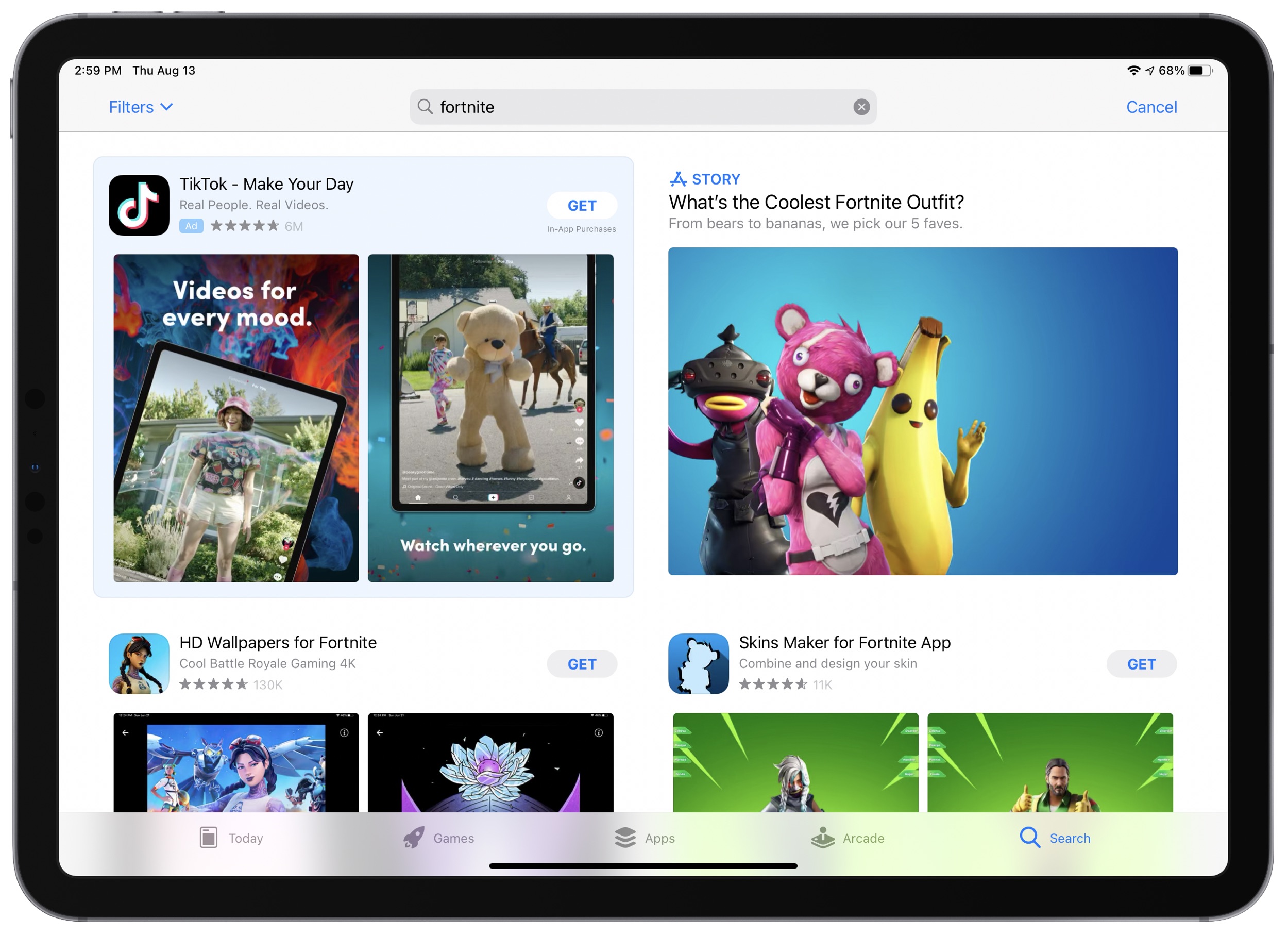
Just hours after Epic Games introduced a new direct payment option for Fortnite that skirts Apple's in-app purchase rules, Apple has pulled the Fortnite app from the App Store.


Fortnite is no longer available for download on the iPhone or the iPad, and Apple provided a statement to MacRumors on Fortnite's removal:
Today, Epic Games took the unfortunate step of violating the ‌App Store‌ guidelines that are applied equally to every developer and designed to keep the store safe for our users. As a result their Fortnite app has been removed from the store. Epic enabled a feature in its app which was not reviewed or approved by Apple, and they did so with the express intent of violating the ‌App Store‌ guidelines regarding in-app payments that apply to every developer who sells digital goods or services.

Epic has had apps on the ‌App Store‌ for a decade, and have benefited from the ‌App Store‌ ecosystem - including it's tools, testing, and distribution that Apple provides to all developers. Epic agreed to the ‌App Store‌ terms and guidelines freely and we're glad they've built such a successful business on the ‌App Store‌. The fact that their business interests now lead them to push for a special arrangement does not change the fact that these guidelines create a level playing field for all developers and make the store safe for all users. We will make every effort to work with Epic to resolve these violations so they can return Fortnite to the ‌App Store‌.
This morning, Epic Games began letting players purchase 1,000 V-Bucks in the Fortnite app for $7.99, with the purchases going directly to Epic Games rather than using Apple's in-app purchase system.

At the time, it was not known if Epic Games had some kind of special permission from Apple to introduce such a feature as it is a clear violation of Apple's ‌App Store‌ rules surrounding in-app purchases. Given that the app has now been pulled from the ‌App Store‌, it appears that Epic Games willingly violated Apple's requirements by offering the direct payment plan.

Rule 3.1.1 of Apple's ‌App Store‌ guidelines states that apps that offer in-game currencies need to use the in-app purchase mechanism. Apps are prohibited from including buttons, links, or other calls to action that ask customers to use non-Apple approved payment methods.
3.1.1 In-App Purchase:
- If you want to unlock features or functionality within your app, (by way of example: subscriptions, in-game currencies, game levels, access to premium content, or unlocking a full version), you must use in-app purchase. Apps may not use their own mechanisms to unlock content or functionality, such as license keys, augmented reality markers, QR codes, etc. Apps and their metadata may not include buttons, external links, or other calls to action that direct customers to purchasing mechanisms other than in-app purchase.
Epic Games made the direct payment option available in the in the United States, Canada, Australia, France, Germany, Spain, the United Kingdom, and other countries, and said that because apps that offer real-life goods and services like Uber and StubHub are not required to use Apple's in-app purchase mechanism, Fortnite should be entitled to the same treatment. Epic Games has also called Apple and Google's 30 percent commission on in-app purchases "exorbitant."

In response to Apple's statement and the removal of Fortnite from the ‌App Store‌, Epic Games announced a new Nineteen Eighty-Fortnite short premiering at 4:00 p.m. Eastern Time, which appears to be a riff on Apple's famous 1984 ad.


Epic Games' stand against Apple comes as Apple is facing a U.S. antitrust investigation over its ‌App Store‌ rules and policies and as Apple is recovering from another very public dispute over the "Hey" email app.

Update: Epic Games has filed a lawsuit against Apple for pulling Fortnite from the ‌App Store‌. [PDF]

In the filing, Epic Games accuses Apple of being a "the behemoth seeking to control markets, block competition, and stifle innovation" and imposing "anti-competitive restraints" and using "monopolistic practices in markets" against ‌App Store‌ developers.
Apple imposes unreasonable and unlawful restraints to completely monopolize both markets and prevent software developers from reaching the over one billion users of its mobile devices (e.g., ‌iPhone‌ and ‌iPad‌) unless they go through a single store controlled by Apple, the ‌App Store‌, where Apple exacts an oppressive 30% tax on the sale of every app. Apple also requires software developers who wish to sell digital in-app content to those consumers to use a single payment processing option offered by Apple, In-App Purchase, which likewise carries a 30% tax.
With the lawsuit, Epic Games says it is not aiming for a cash payout, but instead wants to secure "injunctive relief" in the iOS App distribution market and payment processing market for " hundreds of millions of consumers and tens of thousands, if not more, of third-party app developers."

This article, "Apple Removes Fortnite From App Store [Update: Epic Files Lawsuit Against Apple]" first appeared on MacRumors.com

Discuss this article in our forums


from MacRumors: Mac News and Rumors - All Stories https://ift.tt/31KdVAa

95% of Chinese Users Surveyed Would Rather Give Up Their iPhones Than Lose WeChat

https://ift.tt/2XJ3oUP

As a ban on WeChat and other apps originating in China looms, companies who do business in China and iPhone users in the country are concerned about how the ban could impact device sales and daily device usage.


It's still unclear whether the ban applies to the WeChat app only in the United States or if it will result in the removal of the WeChat app from iPhones across the globe. Tencent, which owns WeChat, said it believes the ban applies only in the U.S., but it is seeking clarity. The wording in the executive order is vague, banning any transaction that is related to WeChat, and it is up to the Commerce Department to work out the details.

A WeChat ban in the United States has the potential to cause a minor drop in sales, but a WeChat ban in China would be devastating for Apple as many Chinese ‌iPhone‌ users feel their devices would be useless without the WeChat app.

In a Weibo survey highlighted by Bloomberg, for example, 95 percent of the 1.2 million people who responded said they would switch to an Android smartphone over an ‌iPhone‌ rather than give up WeChat. WeChat has more than 1.2 billion monthly active users, many of them in China.

One user in Hong Kong, Kenny Ou, told Bloomberg that a WeChat ban would turn the ‌iPhone‌ into "electronic trash," while another, Sky Ding, said WeChat is so important that most Chinese users would prefer to swap phones. "My family in China are all used to WeChat and all our communication is on the platform," said Ding.

Many U.S. companies, including Apple, Ford, Walmart, and Disney have been aiming to convince the Trump administration not to ban WeChat. According to The Wall Street Journal, more than a dozen U.S companies raised concerns in a call with White House officials on Tuesday, with Apple included in the call.
"For those who don't live in China, they don't understand how vast the implications are if American companies aren't allowed to use it," said Craig Allen, president of the U.S.-China Business Council. "They are going to be held at a severe disadvantage to every competitor," he added.
In a recent note to investors, Apple analyst Ming-Chi Kuo said that global ‌iPhone‌ shipments could decline by 25 to 30 percent if Apple is forced to remove WeChat from its App Store worldwide. If WeChat is only removed from the U.S. ‌App Store‌, however, ‌iPhone‌ sales could be impacted by 3 to 6 percent.

The Trump administration is aiming to ban all U.S. transactions with ByteDance (which makes TikTok) and Tencent. The ban was announced on August 7 and there are 39 days left before it goes into effect.

Note: Due to the political or social nature of the discussion regarding this topic, the discussion thread is located in our Political News forum. All forum members and site visitors are welcome to read and follow the thread, but posting is limited to forum members with at least 100 posts.
Tag: WeChat

This article, "95% of Chinese Users Surveyed Would Rather Give Up Their iPhones Than Lose WeChat" first appeared on MacRumors.com

Discuss this article in our forums


from MacRumors: Mac News and Rumors - All Stories https://ift.tt/3iCRTGh

Some Chromebooks now support the Android Emulator for developers


via About Chromebooks https://ift.tt/30TqH05